Vol. 1 No. 111 (2026): Society and Administration
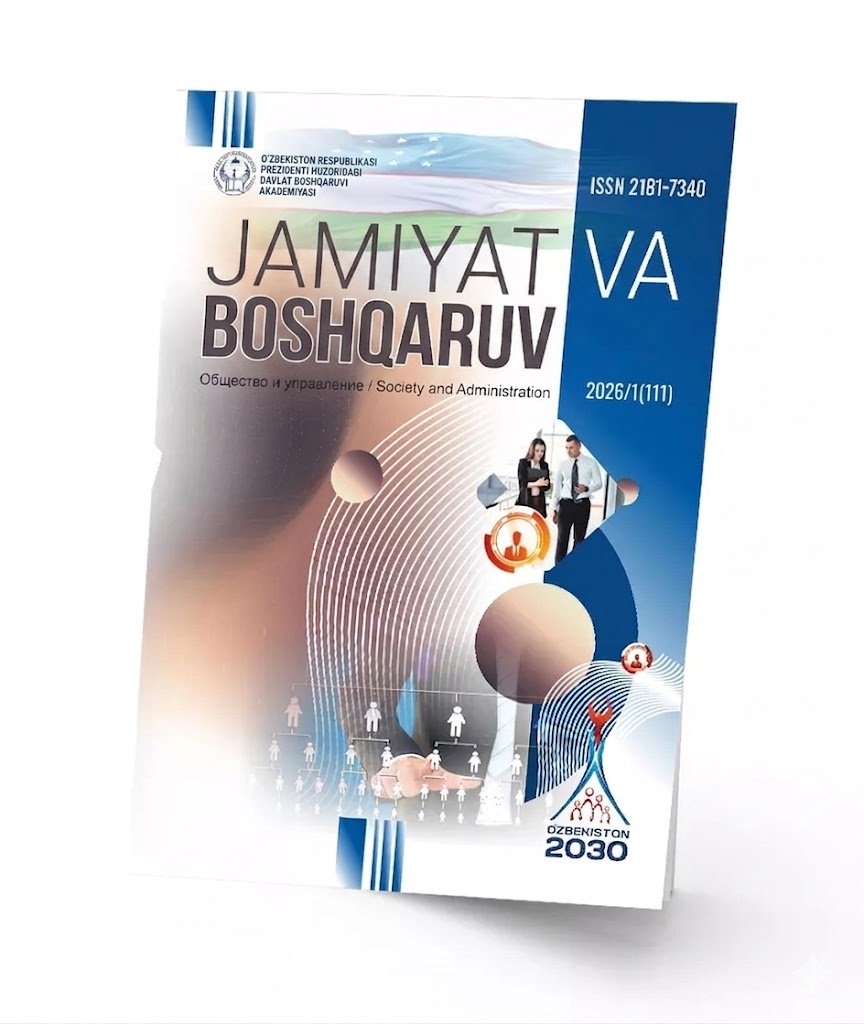
Vol. 1 No. 111 (2026): Society and Administration
Published: 21-04-2026

The journal is included in the list of mass media recommended by the Higher Attestation Commission under the Ministry of Higher Education, Science and Innovation of the Republic of Uzbekistan for publishing scientific articles based on the results of research conducted in the field of socio-economic sciences.
Articles

Eurasian economic community (EurAsEC): evolution of formation and comparative analysis with other integration models

This article examines the institutionalization of regional integration processes in the post-Soviet space, specifically in Central Asia, using the example of the Eurasian Economic Community (EurAsEC). The historical evolution and legal foundations of the organization are analyzed, from the 1995 Customs Union to the 2000 Astana Treaty. The article provides a comparative analysis of EurAsEC's governance system with the models of the European Union and ASEAN. It highlights the organization's significance in transport, energy, and labor migration sectors, as well as Uzbekistan's participation and prospects within this integration framework. The transformation of EurAsEC into the Eurasian Economic Union (EAEU) is evaluated as a new stage of integration.

Anvar Yuldashev (Author)
125-134 22 10
Preventing corruption in budgetary processes is a guarantee of development and prosperity

In our country, the issues of fighting corruption have taken an important place in the state policy, and many legal and institutional reforms have been implemented in this regard. The article analyzes the prevention of corruption in budgetary processes as a guarantee of development and prosperity.

Sayora Makhmudova (Author)
117-124 15 6
A New Insight into Structural Transformation: Assessing Economic Shifts in New Uzbekistan

This article analyzes the processes of structural transformation in the economy of New Uzbekistan. It examines changes in the sectoral structure of GDP and identifies new drivers of economic growth. Particular attention is paid to assessing structural changes through technological development and R&D intensity indicators. The results show a positive shift after 2016, although the economy remains dominated by low and medium-low technology sectors. The article concludes with policy recommendations aimed at accelerating technological upgrading and sustainable structural transformation.

Jamoliddin Ismailov (Author)
109-116 26 20
An uncompromising fight against corruption is an important strategic task

In times of climate crisis, instability and polarization, the world's people need more than ever responsible leaders and independent institutions to protect the interests of the global community - yet they are often lacking. This research paper presents a comprehensive review of the strategy for large-scale reforms to create a corruption-free environment in Uzbekistan.

Farrukh Gaybullayev (Author)
101-108 11 7
Аnalysis of the legal framework for detecting corruption-related crimes and exposing persons who commit them

The article analyzes the content of national regulatory legal acts for the identification of corruption crimes and the disclosure of persons who committed them, and international documents, and develops proposals and recommendations on the elimination of loopholes in them.

Qahramon Ergashev (Author)
90-100 12 4
Hidden powers of the president: concept, classification and comparative legal analysis

The article analyzes the scientific and theoretical aspects of the hidden powers of the president, which are not directly provided for in the constitutional text but are widely exercised in practice; alternative terminological designations of this political-legal institution in foreign literature have been comparatively studied and cross-referenced; entering into scholarly debate with American, European and CIS scholars, the author's original conclusions have been formulated; the powers of the head of state in this category under the new edition of the Constitution of the Republic of Uzbekistan have been revealed through comparative legal analysis with the legislation and practice of foreign states.

Алимов Боту (Author)
25 20
The Center of Islamic Civilization as the visiting card of Central Asian Civilization

This study examines the Center of Islamic Civilization as a multidimensional institution operating at the intersection of heritage preservation, national identity construction, and cultural diplomacy. The article evaluates the Center’s role in reconstructing historical memory, promoting Uzbekistan’s civilizational legacy, and strengthening the country’s soft power in international relations. The findings suggest that the Center functions not merely as a museum or academic institution but as a strategic state instrument for redefining Uzbekistan’s domestic identity and international image. The study concludes that the cultural institution has emerged as an important mechanism through which Uzbekistan projects itself as a modern inheritor of Islamic intellectual heritage and a leading force in regional cultural diplomacy.

Professor, Shavkat Toshev (Author)
76-81 36 20
Enhancing the organizational-economic mechanism of the textile industry in Uzbekistan

This article examines the development of Uzbekistan’s textile and apparel industry through the lens of its organizational-economic mechanism and identifies the main directions for its improvement under current conditions. The study analyzes sectoral dynamics for 2016-2025, focusing on production trends, structural change, and the industry’s role in national industrial development. The results show that recent sectoral growth has been driven mainly by real output expansion rather than by price effects, while the ARIMA (0,2,1) model indicates continued growth through 2028. On this basis, the article substantiates practical directions for modernization, deeper processing, export competitiveness, and stronger coordination within the industry.

Golibjon Yuldashev (Author)
60-75 21 15
The role of digital transformation in optimizing digital government activities

The article provides a comprehensive analysis of the implementation of a unified digital platform within public administration in the context of e-government and digital government. It examines the development trends of e-government in Uzbekistan, along with the key priorities of the «Digital Uzbekistan–2030» strategy, including strengthening interagency integration and introducing data-driven and intelligent governance mechanisms. Based on a sociological approach, the study explores the social nature, institutional characteristics of digital and e-government, and the system of relationships formed within the framework of public administration.

Khojiev Zavkiddin (Author)
50-59 19 75
“Think tanks” or “analytical centers”: role in state and public administration

Rapid changes in political processes, the increase in the volume and flow of information, and the emergence of new geopolitical risks and threats make it difficult to make certain political decisions. In these conditions, the issue of close cooperation in public administration with “think tanks” functioning as specialized and independent information and analytical institutions is acquiring urgent importance. This research article examines the activities, types, and operating principles of think tanks. Particular attention is paid to the development of think tanks and analytical associations in Uzbekistan.

Sanjar Saidov (Author)
42-49 18 30
Transformation of the institutional environment of public-private partnerships in the Kyrgyz Republic: evolution and synergy

This article examines over a decade of experience in the development of public-private partnerships (PPP) in Kyrgyzstan. It analyzes the transition from an outdated concession-based model to more contemporary and flexible forms of cooperation. The study identifies key barriers, including political risks and the absence of a comprehensive risk assessment methodology, and proposes measures to enhance the legislative framework through digitalization and the sectoral differentiation of programs.

Cholpon Alkadyrova (Author)
35-41 16 168
Implementation of Artificial Intelligence (AI) Technologiesin Parliaments: International and National Experience

The article examines the integration of digital transformation and artificial intelligence (AI) technologies into parliamentary activities. The study analyzes foreign experience from the Inter-Parliamentary Union (IPU), parliaments in Europe and the USA, as well as the digitalization reforms of the Uzbekistan parliament. The article highlights the role of AI in legislative processes, analytical functions, and improving interaction with the public, while also addressing data security, algorithmic bias, and ethical risks. Based on the study, policy and legal recommendations are proposed for the Uzbekistan parliament regarding step-by-step AI integration under human control (human-in-the-loop), testing in a “sandbox” environment, and compliance with ethical standards.

Dr. Eshankulov (Author)
25-34 22 12
The Socio-Political Nature of Mass Disturbances

This scientific article provides a comprehensive analysis of the socio-political nature of mass unrest. It reveals the causes of their emergence, their impact on societal stability, and their interconnection with socio-political processes. Factors such as economic inequality, social injustice, political distrust, and information manipulation are considered as the main sources of protest movements. The study also examines the stages of development of mass unrest, their threats to security and the legal system, as well as the response of state and public institutions to these processes. As a result, the research develops scientific and practical recommendations for preventing mass unrest, managing them, and ensuring social stability.

Maxsudjon Mansurov (Author)
19-24 20 10
MECHANISMS AND REGULATIONS FOR STAFFING THE POSITIONS OF THE STATE CIVIL SERVICE

The article aims to analyze the mechanisms and procedures for recruiting personnel to the positions of the state civil service. The article analyzes the methods of training and selection of personnel for the job groups of the state civil service. According to it, two different procedures for entering the state civil service are distinguished. The article analyzes the procedures of the elections, statistical data of the elections held in 2020-2026. The author researched the National Personnel Reserve system for the formation of managerial personnel. Effective mechanisms of effective use of the National Personnel Reserve have been put forward. Based on the research, a number of suggestions and recommendations have been put forward regarding the improvement of the state civil service staffing system.

Oʻzbekiston Respublikasi Prezidenti huzuridagi Davlat siyosati va boshqaruvi akademiyasi (Author)
9-18 24 12
Prospects  for the development of science in public  administration  in  Uzbekistan

This article describes the prospects for the development of science in public administration in Uzbekistan. It assesses the importance of this area and substantiates the importance of innovation and scientific development in public administration. Citizen participation in the development of science in public administration is highlighted. Proposals for integrating science into public administration in Uzbekistan are developed.

Dilfuza Raximova (Author)
3-8 27 18